Drain Camera Inspection vs CCTV Drain Survey: Which Do You Need?
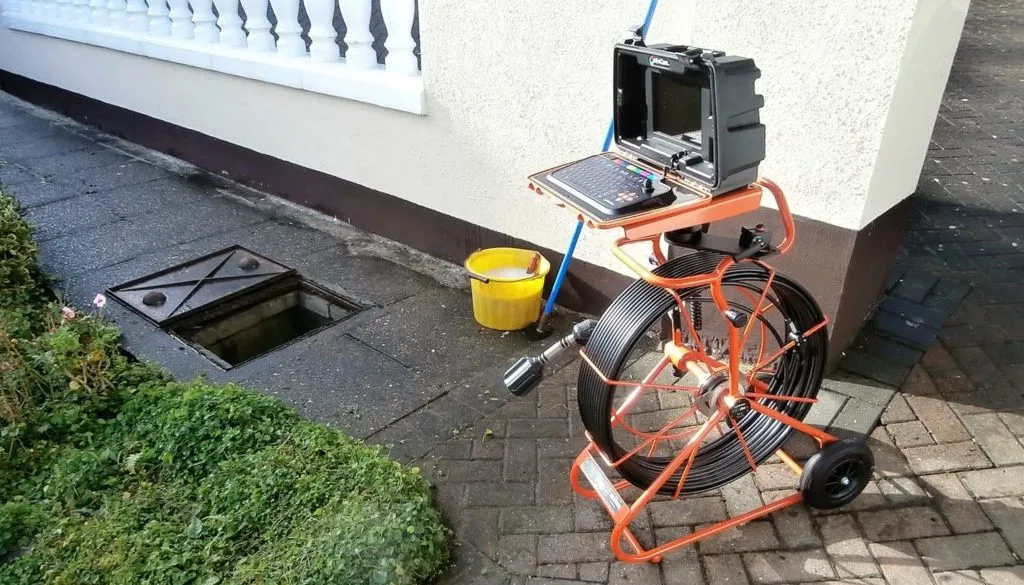
The same camera can produce a quick look or a formal document. Which one you need depends on who will read the result and what decision rides on it.
A drain camera inspection and a CCTV drain survey use the same kind of equipment, but they are not the same job. An inspection is a look down the pipe to answer a practical question on the day. A survey is a recorded, measured and coded investigation that ends in a written report someone else can rely on. Booking the wrong one is how people end up paying twice.
The difference in one sentence
An inspection tells the engineer what is wrong; a survey tells everyone else, in a form they can check. If the only person who needs the answer is the engineer standing at the chamber, an inspection is usually enough. If a solicitor, insurer, landlord, managing agent or building control officer needs it, you need a survey.
The equipment overlaps heavily. Both use a camera head on a push rod or a wheeled crawler, with a monitor at the surface. What differs is what happens around the footage: whether it is recorded in full, whether distances are measured from a fixed start point, whether defects are classified against a standard, and whether the findings are written up.
What a camera inspection gives you
A camera inspection is a diagnostic look, often done during or straight after clearing a blockage. It answers questions like whether the blockage is fully gone, what caused it, and whether there is an obvious defect such as a root mass or a displaced joint.
- Live viewing of the pipe, usually with the customer shown the screen.
- Sometimes a short clip or a few stills, not always the full run.
- A verbal explanation of what was seen, and a recommendation.
- Often the approximate location of a problem, marked on the ground using a sonde in the camera head.
That is genuinely useful. If a kitchen drain keeps blocking and the camera shows a heavy grease build-up, you know to jet it and change what goes down the sink. You do not need a formal report to act on that.
What a CCTV drain survey adds
A survey adds structure: every run is recorded from a referenced start point, every observation is logged against a distance, defects are coded, each run is graded, and the whole thing is written up with a plan. That is what turns footage into evidence.
| Camera inspection | CCTV drain survey | |
|---|---|---|
| Recording | Live view, sometimes clips | Full recording of each surveyed run |
| Measurement | Approximate | Distance logged against each observation |
| Defect description | Plain-language, verbal | Standard defect codes |
| Condition grading | None | Structural and service grades per run |
| Plan of the drains | Rarely | Site plan with chamber references and run directions |
| Usable by a third party | Seldom | Yes: that is its purpose |
Our reports use WRc-adopted defect coding, which is why a surveyor, loss adjuster or conveyancer who has never been to the property can read them. What the grades and codes mean is covered in detail in how to read a CCTV drain survey report.
When an inspection is enough
An inspection is enough when the decision is yours alone and the question is narrow. That covers most one-off blockages and most checks after a clearance.
- Confirming that a blockage has been cleared along its full length, not just pushed further down.
- Finding out why a single fitting keeps blocking.
- Locating a known fault so a repair can be dug or lined in the right place.
- Checking a short run before or after routine maintenance.
In these cases, paying for a full written survey buys a document nobody will read. Ask for a short clip or stills of anything significant, and keep them.
When only a written survey will do
You need a survey whenever someone other than you has to rely on the findings, or whenever money or liability depends on them. Buying a house, making an insurance claim, a dispute with a neighbour or water company, a build-over application, or handing a building over to a managing agent all fall into this category.
For a purchase, a conveyancer needs to know whether a defect is on the private drain or the public sewer and how serious it is; an inspection clip does not say either. Our guide to drain surveys when buying a house covers what to ask for. For a claim, an insurer or loss adjuster needs time-stamped footage, located defects and a stated cause, which is why claim work is always a survey, set out on our drainage insurance claims page.
A survey is also the better choice when a problem keeps coming back. Recurring blockages on the same run often have a structural cause, such as a displaced joint or an intruding connection, that an inspection sees but does not record in a way that can be compared next time.
Questions to ask before you book
The simplest way to avoid paying twice is to agree in advance what you will receive. Ask three questions when booking any camera work.
- Will I get a written report, and is it included in the price? Some low-cost surveys are footage only, with the report charged separately.
- Will every run be surveyed, or only the problem section? A report covering one run is fine for a repair, not for a house purchase.
- Will the report identify where private drainage ends and public sewer begins? This is the question most third parties care about.
Our CCTV drain survey service explains what our reports contain, and our pricing page shows how survey work is charged. If you are not sure which one you need, tell us who will read the result and we will tell you honestly whether a simple inspection is enough.
Frequently asked questions
Is a drain camera inspection cheaper than a CCTV survey?
Usually, because it takes less time on site and involves no written report. The saving disappears if you later need the findings for a purchase, a claim or a dispute, because the work generally has to be repeated as a proper survey. Decide who will read the result before you book.
Can inspection footage be turned into a report afterwards?
Sometimes, but rarely well. A report depends on measured distances from a fixed start point, full coverage of each run and a clear view of every defect. Footage shot as a quick look usually lacks at least one of those, so a surveyor may not be able to code or grade it with confidence.
Does a camera inspection show who owns the drain?
Not on its own. Ownership depends on which properties connect into a pipe and where it crosses the boundary. A survey that records every run and junction, compared with the sewer records, is what establishes where your private drain ends and the public sewer begins.