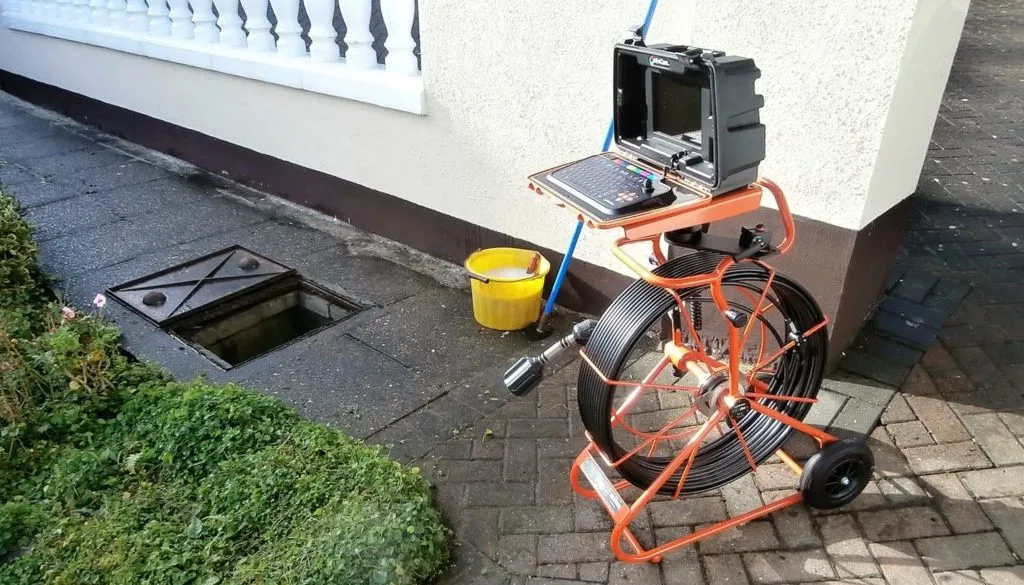
For a typical London house with clear, flowing drains, a CCTV survey usually takes one to two hours on site. Blockages, missing chambers and long runs add time, and the written report follows separately. Here is what happens and how to keep it moving.
A CCTV drain survey of a typical London house usually takes one to two hours on site. It takes longer if the drains have to be cleared before the camera can see anything, if there are several long runs, or if access points are missing or hard to open. The written report is a separate step that happens after the visit, and how long it takes depends on how many runs were surveyed and how detailed the report needs to be.
How long does the site visit take?
For a house with two or three inspection chambers and clear, flowing drains, expect roughly an hour or two. Flats, larger houses and commercial buildings take longer, mainly because there is more pipe to survey.
The camera itself moves quickly. Most of the time on site goes on everything around it: finding and lifting covers, checking flow, setting the distance counter at each access point, stopping to record each defect, and where needed locating a point from the surface. A short, straight run from a back-garden chamber to the front can be done in minutes. A long run under a building, with bends and several branch connections, can take a good deal longer because each connection has to be observed and noted.
| Property | What usually drives the time |
|---|---|
| Terraced or semi-detached house | Number of chambers and whether the runs are clean |
| Detached house or large garden | Length of the runs and any soakaway or rainwater system included |
| Block of flats | Number of stacks, shared chambers and access to each flat |
| Restaurant, shop or office | Grease or heavy deposits, deep chambers and trading hours |
What happens during the survey, step by step
The engineer locates and opens the access points, checks the drains are running, then passes the camera through each run in turn and records what it sees. Here is the usual sequence.
- Locate and lift the covers. Inspection chambers, rodding eyes and any gullies the camera can enter.
- Check the flow. Run a tap or flush a toilet to see which chambers carry what, and whether anything is backing up.
- Clean if needed. A blocked or heavily fouled run is jetted first so the pipe wall is visible, unless there is a reason to record it as found.
- Survey each run. The camera goes in from a chamber, with the distance counter zeroed at that chamber, and every defect and connection is recorded with its position.
- Locate from the surface where needed. A sonde in the camera head lets the engineer mark on the ground where a defect sits, or where a pipe runs under a building.
- Put covers back and tidy up. Any damaged or seized covers are noted for the report.
What makes a CCTV survey take longer?
Blockages, missing access points and long or deep runs are the usual reasons a survey runs over. London properties add a few of their own.
- Blockages or heavy deposits that have to be cleared before the camera can see the pipe.
- No chamber where one is needed. A run that can only be reached from one end, or a chamber buried under a patio, slows everything down.
- Seized or concreted covers, common in older front gardens and basement areas.
- Collapsed or badly displaced sections that stop the camera, so the run has to be surveyed from the other end.
- Deep chambers on commercial sites, where entry needs gas monitoring and additional safety arrangements.
- Shared chambers in a neighbour's garden or a communal area, which need permission to open.
- Parking and access for a jetting unit on a busy street.
How long does the report take?
The report is written up after the visit from the recorded footage, so it always arrives later than the engineer leaves. How much later depends on the size of the survey and the type of report.
A short verbal summary on the day is normal: whether the drains are sound, where the problems are, and whether anything is urgent. A full coded report, with each defect graded and located and the runs shown on a sketch plan, takes longer to prepare because every observation is checked against the footage. If a solicitor, lender, insurer or managing agent is waiting on it, say so when you book and agree the turnaround then, rather than finding out after the visit. Our guide on how to read a CCTV drain survey report explains what that document should contain.
Do you need to be at home, and how can you speed it up?
Someone needs to give access to the chambers and, for most surveys, to the inside of the property so fittings can be run. You do not need to watch the whole survey, but it helps to be there at the start and the end.
- Know where your covers are, or at least clear anything stacked on top of them.
- Tell the engineer about past problems: where it blocks, where it smells, where the ground has sunk.
- Arrange access to shared chambers with neighbours or the managing agent before the day.
- Keep water use low while the camera is in a run, unless the engineer asks you to run a tap to trace a fitting.
When a quick look is enough, and when it is not
If you only want to know why a single drain keeps blocking, a short camera inspection may answer it in minutes. If the result has to support a purchase, a repair specification or an insurance claim, you need a full coded survey, and that takes the time it takes.
The difference between the two is explained in our comparison of a drain camera inspection and a CCTV drain survey. Choosing the shorter option to save an hour usually costs more later, because a quick look rarely produces a document anyone else will rely on. Details of what we include as standard are on the CCTV drain survey page.
Frequently asked questions
Can a CCTV drain survey be done in one visit?
Usually, yes. Most domestic surveys are completed in a single visit, including any cleaning needed to get a clear view. A second visit is sometimes needed if a run can only be reached from a chamber on a neighbour's property, if a cover cannot be opened, or if a collapse stops the camera and the run has to be surveyed from the other end.
Do I need to be home for a drain survey?
Someone usually needs to give access to the property so toilets, sinks and gullies can be run to confirm which fittings connect to which drain. If every chamber is outside and accessible, and the fittings do not need to be traced, the survey can sometimes be done without anyone indoors. Agree this when you book.
Will I get the survey results on the day?
You should get a verbal summary on the day: whether the drains are sound, where any defects are and whether anything is urgent. The full coded report with grades, positions and a sketch plan is written up afterwards from the footage. If you have a deadline, agree the report turnaround when you book.