What Is a Rising Main in Drainage? Faults, Surveys and Ownership
Where a property sits too low to drain by gravity, a pump pushes the waste uphill through a rising main. Here is how that pipe works, the faults it develops, why it is harder to survey than an ordinary drain, and who is responsible for it.
In drainage, a rising main is the pipe that carries pumped sewage or surface water under pressure from a pump chamber up to a point where it can flow on by gravity, usually a manhole on the ordinary drain or sewer. It is also called a pumping main or force main. It is not the same thing as the rising main on your water supply, which is the incoming cold-water pipe, or the dry and wet risers used for firefighting in taller buildings.
Where rising mains are used
A rising main is needed wherever waste has to go uphill to reach the sewer. In London that most often means basements, which usually sit below the level of the sewer in the street.
Typical examples are basement flats and conversions with a toilet, shower or kitchen below ground, excavated basements under Victorian and Edwardian houses, commercial kitchens and plant rooms below street level, and newer developments where the site falls away from the public sewer. In each case the waste runs by gravity into a pump chamber. When the level rises, a pump starts and pushes the contents through the rising main to a higher chamber, often called the discharge chamber, from where gravity takes over again.
How a pumped drain is laid out
A pumped system has more parts than a gravity drain, and most of them sit at the pump end. Knowing what they are makes a survey report much easier to follow.
- Pump chamber. The sump where waste collects, with one or two pumps and a float or level sensor to start and stop them.
- Non-return valve. Stops the column of water in the rising main from running back into the chamber when the pump stops.
- Isolation valve. Lets the rising main be shut off so the pump or non-return valve can be worked on.
- The rising main itself. Usually a plastic pressure pipe, much smaller in bore than a gravity drain, often with few or no access points along its length.
- Air valves. Sometimes fitted at high points on longer mains to let trapped air out.
- Discharge chamber. The gravity chamber where the rising main outfalls, and where the pumped flow joins the normal drainage.
What goes wrong with a rising main
Most problems show up as a pump that runs too often, runs for too long, or cannot keep up. The cause is usually one of a small number of faults.
A failed non-return valve lets pumped water run straight back into the chamber, so the pump cycles again and again. Blockages build up from wipes, rags and fat, which pumps do not always pass cleanly, and the narrow bore makes a rising main less forgiving than a gravity drain. Air locks at high points reduce flow. Leaks are harder to find than on a gravity drain because the pipe is under pressure and the escaping water goes into the ground rather than showing at a chamber. Signs include wet ground along the route, a pump that runs longer than it used to, or a discharge chamber receiving less than it should.
The discharge chamber has its own problems. Sewage that sits in a long main between pump cycles can turn septic, and where it reaches the discharge chamber it can release hydrogen sulphide. That causes persistent smells and, over time, attacks concrete and brickwork in the chamber. A smell at one particular manhole downstream of a basement pump is often this rather than a blocked drain.
How a rising main is surveyed
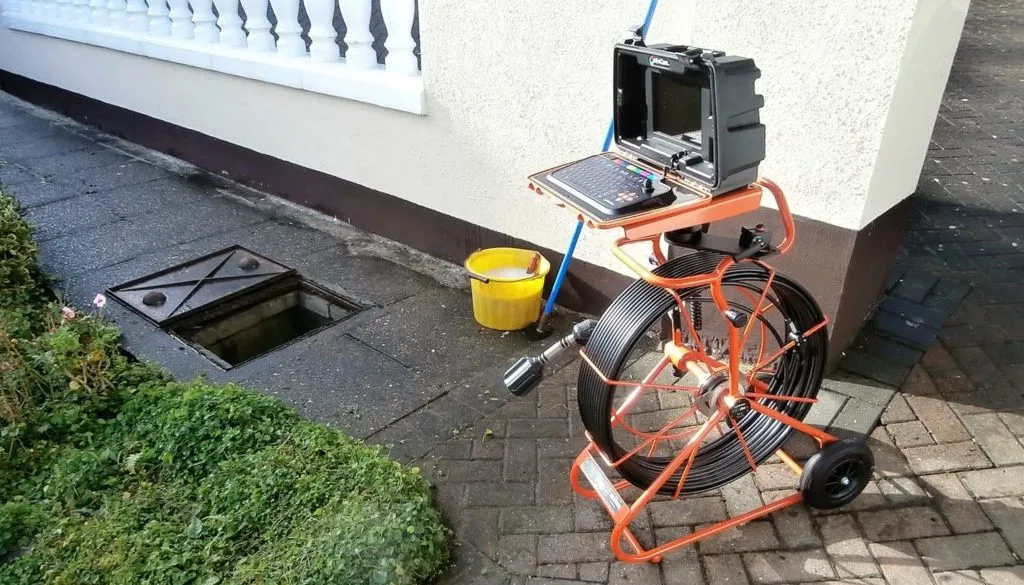
A rising main can be inspected by CCTV, but only with the pump isolated and the pipe drained or at least relieved of pressure, and access is the main limit. A gravity drain can be surveyed from any chamber. A rising main often only offers the discharge end and the pump end.
A survey of a pumped system normally includes the following:
- The pump chamber: its condition, what is sitting in it, the float or level controls and whether the non-return and isolation valves are present and working.
- The rising main: a small push-rod camera sent in from the discharge end or from an access fitting where one exists, recording deposits, displaced or badly made joints and damage. On long mains with several bends the camera may not reach the whole length, and the report should say so.
- A pressure test, where a leak is suspected, to see whether the main holds pressure.
- The discharge chamber and downstream drain, surveyed by standard CCTV, looking for corrosion, deposits and whether the outfall is set correctly.
Tracing is often part of the job. A plastic pressure pipe cannot be found with a cable locator on its own, so the route is usually traced with a sonde carried on the camera rod, and plotted onto a plan. Our drain tracing service covers that part, and a CCTV drain survey covers the gravity drains either side.
Who owns a rising main?
A pump and rising main that serve only your property, and sit within its boundary, are yours to maintain. Some shared private pumping stations, broadly those serving more than one property and connecting to the public sewer, passed to the water companies in England in October 2016.
In practice this means a single house with a basement pump owns the whole system down to the discharge chamber. For a block of flats with a shared pumping station, the answer depends on the layout, and Thames Water can confirm whether a particular station is theirs. Where the pump is private, the freeholder or management company is usually responsible for it, which is why managing agents should have it on the building's maintenance schedule. Our guide to drain surveys for blocks of flats covers how shared drainage is usually recorded.
When a survey is the wrong first step
If a pump alarm is sounding or the pump has stopped, the first job is getting the pump running and the chamber emptied, not booking a survey. A camera cannot inspect a main that is full and under pressure, and a failed pump or a tripped electrical supply is a mechanical or electrical fault, not a drainage defect.
A survey earns its place afterwards, or when the problem is persistent: a pump that keeps running, a smell at the discharge chamber that will not go away, wet ground along the route, or a purchase or refurbishment where you need to know what the system is and where it runs. At that point a written record of the chamber, the valves, the route of the main and the condition of the discharge point is worth having. If you are not sure which situation you are in, describe the system to us and we will say what can usefully be inspected.
Frequently asked questions
What is the difference between a rising main and a gravity drain?
A gravity drain relies on a steady fall so waste flows downhill on its own. A rising main is a smaller pressurised pipe that carries waste pushed by a pump, usually uphill from a basement or low site to a manhole where gravity drainage takes over.
Can you put a CCTV camera down a rising main?
Yes, but only with the pump isolated and the main drained or depressurised, and usually only from the discharge end or an access fitting. Access is limited and long mains with bends may not be fully reachable, so the report should state how much of the main was actually seen.
Why does the manhole where my pump discharges smell?
Sewage that sits in the rising main between pump cycles can turn septic and release hydrogen sulphide when it reaches the discharge chamber. That causes smells and can corrode the chamber over time. A survey of the discharge chamber and pump cycle usually confirms whether that is the cause.