Shared Drain Blockage: Who is Responsible for Repairs?
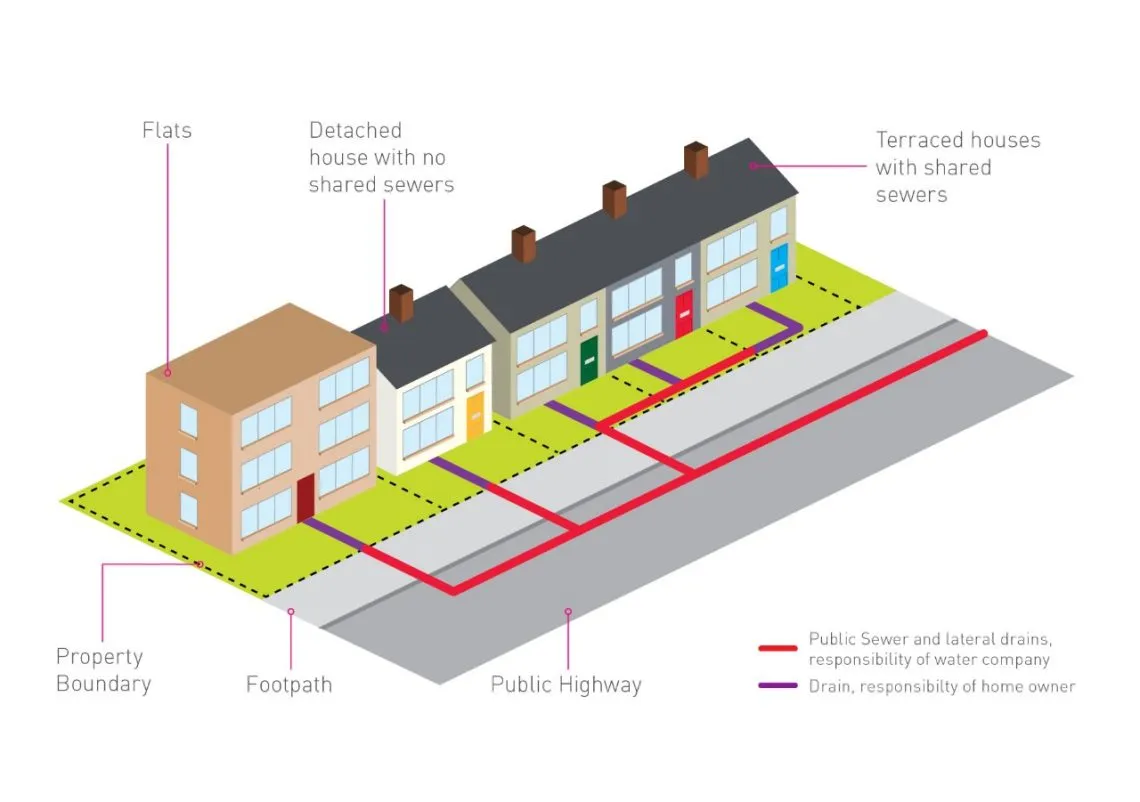
Determining liability for a shared drain blockage hinges on a professional CCTV survey and documented evidence of the defect's location and cause.
The Legal Framework: Public vs. Private Drains
Responsibility for a blocked or damaged drain is legally defined by its location. The key distinction is between the public sewer, which begins where two or more private drains converge, and the private drainage system serving your property. The water company is responsible for maintaining the public sewer. The private drain, up to the point of connection, is the property owner's responsibility.
For terraced houses, semi-detached properties, and flats, this becomes complex. The drain running from your property to the connection point is often shared with a neighbour before meeting the public sewer. This section is known as a 'shared drain' or 'lateral drain'. Legally, all properties using that section are jointly responsible for its maintenance and repair.
The Diagnostic Imperative: CCTV Survey Evidence
You cannot assign responsibility based on symptoms alone. A toilet backing up in two neighbouring houses indicates a shared problem, but not its precise origin. Determining which property is liable, or if liability is joint, requires visual evidence of the defect's exact location.
Our engineers deploy a high-resolution CCTV drain camera. This diagnostic tool is non-invasive and provides a definitive, recorded assessment. The survey maps the drain's condition, identifies the blockage material or structural defect (like a collapsed pipe or root intrusion), and crucially, logs the distance from the access point. This footage and report become the primary evidence for establishing where the problem lies on the drainage system's schematic.
For instance, the camera may reveal a solid fat blockage 5 metres from your inspection chamber, but 15 metres from your neighbour's. This evidence clarifies the section of pipe affected. If the defect is squarely within the shared section, both parties are liable. If it is closer to, or directly outside, one property's boundary, that owner may bear primary responsibility.
From Diagnosis to Resolution: The Procedural Path
Once the CCTV survey provides documented evidence, the path forward is procedural. We provide a clear report with time-stamped footage, still images, and a diagram. This report should be shared with affected neighbours and, if necessary, the water company or insurers.
If the blockage is in the public sewer, we will provide the evidence needed for you to report it to your water authority, who then assume responsibility for the clearance. For private or shared sections, the report defines the scope of works required—be it high-pressure jetting, root cutting, or excavation and repair. For joint liabilities, we can coordinate works and provide separate invoices to each responsible party, based on the agreed share of costs.
Attempting resolution without this evidence often leads to disputes and delayed repairs, exacerbating the problem. The diagnostic investment in a CCTV survey saves significant time and conflict by moving the discussion from conjecture to documented fact.
Documentation: Your Evidence for Disputes and Insurance
The CCTV report serves multiple evidential purposes. Beyond neighbourly discussion, it is often a prerequisite for building insurance claims for drainage repairs. Insurers require proof of the cause and location. Furthermore, should a dispute arise regarding responsibility, this professional documentation is the objective standard upon which a resolution can be based, potentially avoiding legal action.
We archive all survey footage and reports, providing copies whenever needed. This creates a permanent maintenance record for the property, valuable for future sales or ongoing drainage management. Precise diagnosis and thorough documentation are not just our service method; they are the tools that definitively answer the question of responsibility for a shared drain blockage.
Frequently asked questions
How can I prove a drain is shared and where the blockage is?
Definitive proof requires a professional CCTV drain survey. The recorded footage maps the pipework, showing connections from multiple properties and pinpointing the exact location and nature of the blockage. This visual evidence is irrefutable compared to assumptions based on symptoms.
If my neighbour causes the blockage, am I still liable for the cost?
Liability is typically for the section of pipe, not the cause. If the blockage (e.g., from fat or an inappropriate item) is located within the shared drain section, all connected properties are usually jointly responsible for the clearance cost, regardless of whose actions caused it. The CCTV survey establishes the location, which dictates liability.
What happens if the CCTV survey shows the problem is in the public sewer?
We provide you with a full report and evidential footage. You then submit this to your local water company. As the statutory authority for public sewers, they are obligated to clear the blockage at no cost to you. Our documentation ensures a swift, evidence-led handover.