Manhole or Inspection Chamber? How to Tell the Difference
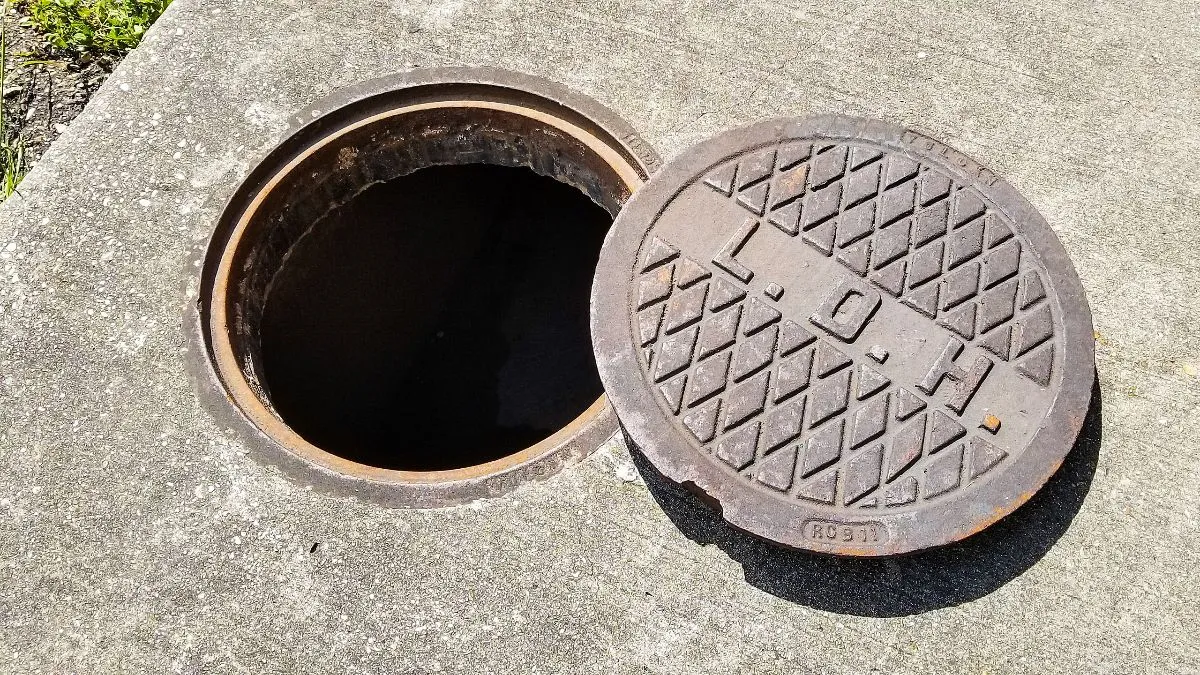
Most covers in a London front garden are not manholes at all. They are shallow inspection chambers, built to be rodded and surveyed from the surface. The difference changes who can work on them, how, and sometimes who owns them.
A manhole is a chamber deep and wide enough for a person to climb into. An inspection chamber is a shallower, smaller chamber that gives access to the drain from the surface without anyone getting in. Most of the covers people call manholes in London front paths and back yards are, strictly, inspection chambers. The distinction matters because it decides how the chamber is surveyed, what a repair involves, and what a report should call it.
The short answer: depth and whether a person goes in
The difference is depth and entry. If the drain is shallow enough to be reached with rods and a camera from ground level, the chamber is an inspection chamber; if it is deep enough that someone has to go down into it, it is a manhole.
Approved Document H of the Building Regulations, which covers drainage, treats them as separate access points with their own minimum sizes. Rodding eyes and access fittings are the smallest. Inspection chambers are next, limited to shallow depths and sized for tools rather than people. Manholes are required where the drain is deeper and larger openings, steps or ladders are needed for safe entry. The regulations set minimum internal dimensions and cover sizes for each category by depth, which is why a deep chamber with a small cover is usually a sign of an older or non-standard installation.
In everyday speech the words are used loosely, and nobody is wrong to call the cover on their path a manhole. In a survey report the difference is not cosmetic. It tells the reader how the chamber can be accessed and what any repair will involve.
How to tell which one you have
Lift the cover, if it is safe to do so, and look at the depth and the construction. A shallow chamber you can see the bottom of from standing, with the channel close to the surface, is an inspection chamber. A deep shaft with step irons or a ladder, or a drop you cannot judge, is a manhole.
- Modern plastic chambers are almost always inspection chambers. They arrive as a moulded base with pre-formed channels and a riser, and they are common on extensions and newer builds.
- Brick chambers in Victorian and Edwardian terraces can be either. Many are shallow, with a half-round channel and sloping concrete benching either side. Deeper ones, especially where the drain runs under a basement or a raised front garden, are true manholes.
- Chambers with an interceptor trap, a U-bend on the outgoing pipe with a small stoppered rodding arm above it, are typical of older London houses. The trap was intended to stop sewer gas entering the house drain, but it is also a frequent blockage point.
- Precast concrete ring chambers are usually on deeper or shared runs and are more often manholes.
If you cannot judge the depth, do not lean in or climb down to find out. Chambers can hold sewer gas and have unstable edges, and a deep chamber is a confined space.
Why the difference matters for surveys and repairs
An inspection chamber is worked entirely from the surface; a manhole may need someone to enter, and entry brings safety procedures, extra equipment and more time. That affects how long a survey takes and what a repair costs.
For a CCTV survey, both types serve as launch points. The camera is lowered into the chamber and pushed or driven along each connected run, and the chamber reference becomes the start point for every measurement in the report. On our CCTV drain surveys each chamber is given a reference on the site plan, with its type, approximate depth, construction and condition recorded, so that anyone reading the report later can find it again.
Where the chamber itself is the problem, the repair depends on the type. Common inspection chamber defects are cracked or missing benching, a broken channel, displaced brickwork, and a lid and frame that no longer sit level. In a manhole the same defects occur, but the work may involve entry, and failed step irons or a deteriorated shaft become part of the job. Our manhole and chamber repair page covers both.
Who owns the chamber on your property?
Ownership depends on which pipes the chamber serves, not on what it is called. A chamber that only takes your own property's drains is normally yours. A chamber on a run shared with neighbours, or on a pipe that has already joined other properties' drainage, is normally the responsibility of the sewerage company, even if it sits in your garden.
This follows the transfer of private sewers and lateral drains to the water companies in October 2011. Before then, many shared runs in London terraces were jointly owned by the households they served. Since the transfer, the pipe usually becomes public at the point where it serves more than one property or crosses the boundary. A chamber at that junction is often public.
You cannot reliably tell ownership by looking at the cover. The practical route is to establish which properties connect into the chamber, which a CCTV survey or dye test shows, and then compare that with the sewer records. Our guide to who is responsible for a shared drain sets out how that plays out when the chamber is blocked.
What a chamber tells an engineer before the camera goes in
A chamber is a useful diagnostic point on its own. The level of water standing in it, and whether the outgoing channel is flowing, usually tells you within minutes whether a blockage is upstream or downstream.
- Chamber full, outlet submerged: the blockage is downstream, between this chamber and the next or the sewer connection.
- Chamber dry while fittings back up: the blockage is upstream, between the house and this chamber.
- Tide marks on the walls: the chamber has surcharged before and cleared, a pattern that often means a partial obstruction or a trap that is slowly failing.
- Roots at the joints or in the channel: the chamber walls or the pipe connections are no longer sealed.
None of this replaces a camera, but it tells the engineer which run to survey first. It is also a check you can make yourself from above, without lifting anything heavy or reaching in, before you phone anyone.
When a chamber needs attention, and when it does not
A chamber needs attention when the cover is cracked, rocking or sunken, when the benching or channel is broken, or when water is getting in or out through the walls. An old chamber that looks rough but drains freely and has a sound cover usually needs nothing.
Brick chambers from the early twentieth century are often patched and uneven. Unless the survey shows a structural defect, loss of flow or infiltration, age alone is not a reason to rebuild. A cracked or collapsing cover is a different matter, because it is a safety risk as well as a drainage one. We cover that in what to do about a cracked or collapsed manhole cover.
If you are unsure whether a chamber on your property is yours, whether it is a manhole or an inspection chamber, or what state it is in, a survey answers all three questions on paper. That record is also what a buyer's solicitor, an insurer or a managing agent will ask for later.
Frequently asked questions
Is every drain cover in a garden a manhole?
No. Most covers on domestic London drainage are inspection chambers, which are shallow and worked from the surface with rods and cameras. A true manhole is deep enough for a person to enter and is more common on deeper or shared runs. Some older properties also have small rodding eyes, which are access points rather than chambers.
Can I lift my inspection chamber cover myself?
You can lift a light domestic cover to look in, taking care with your back and fingers, and never leaning over or climbing into the chamber. Heavy cast iron covers, covers that are seized, and anything on a deep chamber are better left to someone with lifting keys and gas monitoring. Replace the cover securely afterwards.
Who pays to repair a chamber on a shared drain?
If the chamber serves more than one property, it is usually the sewerage company's responsibility following the 2011 transfer of private sewers, even when it sits within your boundary. If it serves only your property, the repair is normally yours. A CCTV survey showing which properties connect into the chamber is the evidence that settles it.