Dilapidation Drain Survey: Recording Your Drains Before Building Work
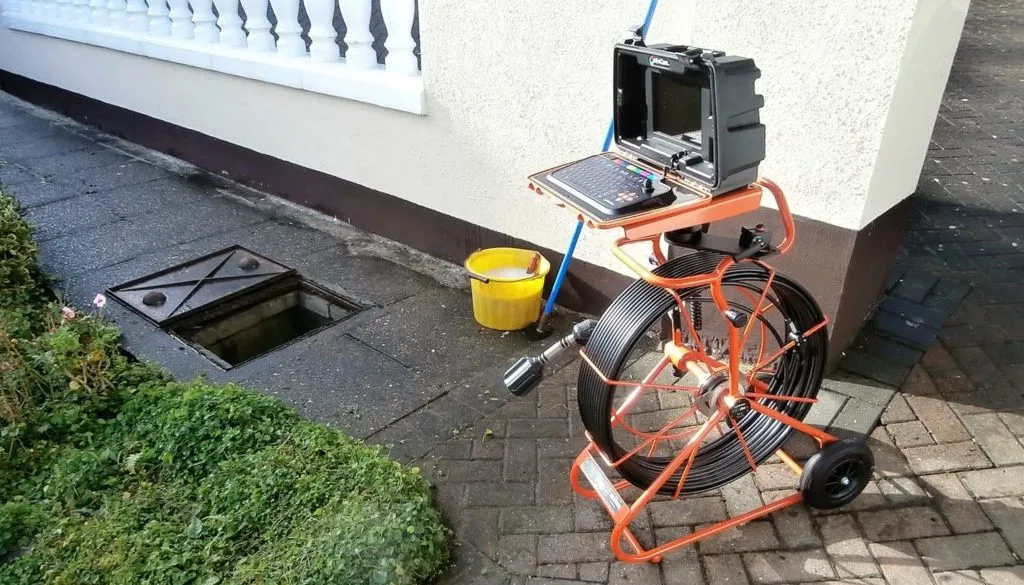
A schedule of condition before a neighbour's basement or extension rarely includes the drains. A dated CCTV survey before and after the works does. Here is what it should record and how the comparison works.
A dilapidation drain survey is a CCTV record of the condition of your drains taken before building work starts next door, or on your own property, and repeated once the work is finished. Comparing the two recordings shows whether the works damaged the pipes. Without the first recording there is usually no reliable way to prove it either way.
What is a dilapidation drain survey?
It is a pre-works condition survey of below-ground drainage, carried out by camera and written up as a dated, coded report. The point is not to find a fault today. It is to fix a baseline that a second survey can be measured against later.
The term borrows from building dilapidation surveys and party wall schedules of condition, which record cracks, stains and defects in walls and ceilings before neighbouring work begins. A drain version does the same job for the pipes under the ground: it records every joint, crack, deformation and connection along each run, with its distance from a named chamber, so the same length can be found and filmed again.
Why a party wall schedule of condition usually misses the drains
Most schedules of condition are visual inspections of the building fabric, so they stop at what a surveyor can see. The drains are out of sight, and unless someone lifts the covers and puts a camera in, they are not part of the record.
That gap matters because drains are one of the parts of a property most exposed to building work. Excavation for foundations or a basement close to a shared boundary, piling, underpinning, heavy plant crossing a front garden, or skips and grab lorries standing on a shallow run can all crack or displace old clay pipes. The Party Wall etc. Act 1996 covers many excavations near a neighbouring building, but the Act itself does not say the drains must be surveyed. It is something the owners or their surveyors have to agree to include.
If you are the adjoining owner, it is reasonable to ask for a drain survey to be added to the schedule of condition. If you are the building owner, commissioning one yourself protects you from being blamed for defects that were already there.
When a pre-works drain survey is worth doing
It is worth doing whenever work will disturb the ground close to a drain, or put heavy loads over one. The closer and deeper the work, the stronger the case.
- A neighbour's basement or extension where the excavation runs along a shared boundary, particularly in Victorian and Edwardian terraces where drains often run behind or under neighbouring gardens.
- Your own extension or loft conversion where a drain runs under or beside the footprint. If the run is a public sewer, Thames Water will also expect a build over agreement with CCTV surveys before and after, which is a separate requirement.
- Piling, underpinning or demolition nearby, where vibration and ground movement can open old joints.
- Road, utility or landscaping work where plant will cross a drive or garden over a shallow pipe.
- Commercial leases where a tenant is about to take on a property and wants the condition of the drains recorded at the start of the term, so it is not argued over at the end.
What the pre-works survey should record
It should record enough that a different engineer, months later, can survey exactly the same lengths and compare like with like. That means references, distances and footage, not just a summary.
- A sketch plan with every chamber numbered and the direction of flow on each run.
- Photographs of each chamber, its cover and its benching, taken before anything is disturbed.
- Full CCTV footage of each run surveyed, with the start chamber, finish chamber and distance counter visible on screen.
- Every defect listed with its position in metres from the start chamber and coded to a recognised standard, so its severity is stated rather than described loosely.
- The date, weather and flow conditions, and whether the pipe was cleaned before filming.
That last point is often overlooked. If a run is jetted before the survey, the recording shows the pipe clean. If the post-works survey is done without cleaning, silt can hide or mimic defects. Both surveys should follow the same method. How the grading and defect codes work is covered in our guide to reading a CCTV drain survey report.
The post-works survey and comparing the two
The post-works survey repeats the same runs from the same chambers once the heavy work is finished, normally after backfilling and before any new surfaces go down. The comparison is then made defect by defect, at the same distances.
A new fracture at a point where the first recording showed sound pipe is strong evidence of damage during the works. A crack that was already recorded but has opened wider, or a joint that has moved further, is evidence the works made an existing defect worse. A defect that appears in both recordings unchanged was there before and is not the building owner's responsibility.
This is also why the first survey should be done close to the start date. A recording from two years earlier leaves room to argue that the damage happened in between.
Who arranges and pays for it
Where the work is covered by the Party Wall Act, the surveys are usually arranged through the party wall surveyors and paid for by the owner carrying out the works, as part of the costs of the award. Outside the Act, it is whatever the two owners agree, or whoever wants the protection.
Either way, agree three things before the first recording: which runs will be surveyed, which chamber each run starts from, and who receives copies of the footage and report. Both owners should hold identical copies. A CCTV drain survey delivered as a written report with the video files meets that need.
When a dilapidation drain survey is the wrong answer
It is the wrong tool when the drain is already blocked, when nobody knows where the pipes run, or when the building work is nowhere near a drain. In each case something else should come first, or nothing is needed at all.
A blocked run has to be cleared before it can be filmed, because a camera cannot see through standing waste. If the route of the drains is unknown, for example because covers have been paved over or the pipe crosses into a neighbour's garden, the route should be established by drain tracing first so the survey covers the right lengths. And if the works are a loft conversion or an internal refit with no digging near a drain, a pre-works drain survey adds cost without adding protection.
Frequently asked questions
Is a drain survey part of a party wall schedule of condition?
Not usually. A schedule of condition is normally a visual record of the building fabric. The drains are only included if the owners or their surveyors agree to add a CCTV drain survey, which is worth asking for where excavation runs close to a drain.
How soon before the works should the first survey be done?
As close to the start date as practical. The nearer the first recording is to the start of excavation, the harder it is to argue that any new damage happened for some other reason in between.
What happens if the second survey shows new damage?
The paired recordings and reports are the evidence. Where the work falls under the Party Wall Act, the surveyors deal with it under the award. Otherwise it is a matter between the owners, and sometimes their insurers, using the two reports to show what changed and where.