Where Does My Rainwater Drain Go? Sewer, Soakaway or Surface Water
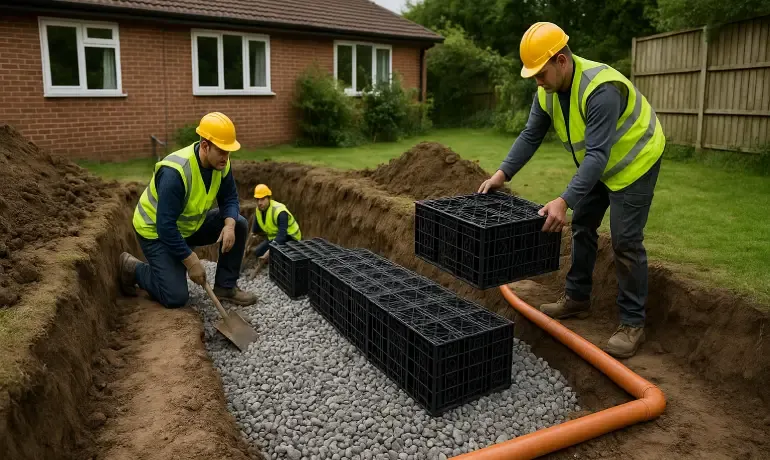
Rainwater from your roof may go to a combined sewer, a surface water sewer or a soakaway, and you rarely can tell from the downpipe. Here is how to find out, what the sewer records show, and why it matters for your bill and building work.
Rainwater from your roof and paved areas goes to one of four places: a combined sewer that carries both rainwater and waste water, a separate surface water sewer, a soakaway in your garden, or occasionally a nearby ditch or stream. Which one applies to your property affects your water bill, what you can connect to it during building work, and who fixes it when it goes wrong. You usually cannot tell by looking at the downpipe; you find out by tracing the pipe.
Where does rainwater go in London?
In much of inner London, rainwater and waste water share the same pipes. The Victorian sewer network was built as a combined system, and many houses from that era send their downpipes and their toilets into the same drain and the same sewer.
Newer estates and many outer-London areas were built with separate systems: a foul sewer for toilets, sinks and appliances, and a surface water sewer for rain, which usually discharges to a river or brook without treatment. Some older suburban houses have a mix, with the roof at the back draining to a soakaway and the front to the road. Extensions, conservatories and loft conversions added over the decades often muddle the picture further, which is why the answer for one house on a street may not hold for the next.
How can you tell where a downpipe goes?
Start with what you can see, then confirm with a test. The outside fittings give clues, but they do not prove where the pipe ends up.
- A downpipe into a trapped gully, often shared with a kitchen or bathroom waste, usually means a foul or combined drain.
- A downpipe straight into the ground through a rainwater shoe or a sealed connection may go to a surface water sewer, a soakaway, or a combined drain further along.
- Lifting inspection chamber covers while someone runs water down each downpipe shows which chambers it passes through. Chambers that also carry toilet waste are foul or combined.
- A dye test, where coloured dye is put into a downpipe and the chambers and outlets are watched, confirms the route when chambers alone do not.
Where the pipe disappears under a patio or never reaches a visible chamber, a camera with a sonde transmitter is pushed along it and located from above, marking the route and depth on the ground. That is the core of our drain tracing service, and it is usually the only reliable way to tell a soakaway from a buried connection to the sewer.
What do the sewer records show?
The water company's sewer records show public sewers, and often whether each one is foul, surface water or combined. They do not normally show the private drains within your property, so they tell you what is in the road, not where your downpipes go.
The records are available through the water company or through a drainage and water search, which conveyancers order during a purchase. They are a useful starting point: if the only sewer in your road is combined, a downpipe that connects to the public network can only be going there. If there is a separate surface water sewer, you still need to confirm which pipe your rainwater actually joins. Our guide to drain mapping and getting a drainage plan explains how the records and a site survey fit together.
Can you get money back if rainwater does not go to the sewer?
Often, yes. Water companies, Thames Water included, include a charge for surface water drainage in the sewerage part of household bills. If none of the rainwater from your property reaches the public sewer, because it all goes to a soakaway or a watercourse, you can usually apply to have that part of the charge removed.
Check the terms with your water company before you apply. For households the reduction generally depends on no surface water from the property reaching the public sewer; a single downpipe or a front drive that drains to the road can be enough to rule it out. The company may ask for evidence or send someone to check. A dye test or a traced drainage plan showing every downpipe and hard surface going to a soakaway is the kind of record that answers the question clearly.
Why the answer matters for building work
A new extension, a loft conversion with a new roof or a paved front garden all add rainwater that has to go somewhere, and the right place depends on what system the property is on.
On a separate system, connecting a new downpipe to the foul drain overloads it in storms, and connecting a new bathroom to the surface water drain sends sewage to a river. Both are misconnections, and both are common after building work. New rainwater should go to a soakaway or other sustainable drainage where the ground allows, and only to a sewer when that is not practical; building control will want to see how it has been dealt with. Making a new connection to a public sewer needs the water company's approval.
Front gardens have their own rule in England: covering more than five square metres with a hard surface that cannot absorb water normally needs planning permission, unless the rain runs to a lawn, border or soakaway within the property or the surface is permeable.
When a rainwater drain causes problems
Rainwater drains fail in ways that are easy to confuse with other faults. A gully that overflows only in heavy rain, damp at the base of a wall near a downpipe, or a soakaway that fills and stays full are all worth investigating before the next wet winter.
On a combined system, a heavy storm can overwhelm the sewer and push water back up through the lowest gully, which is a sewer capacity issue for the water company rather than a fault in your drain. A soakaway that has silted up, or was built in clay, fills and stops working; our guide to why a soakaway is not draining covers the usual causes. A broken rainwater pipe under the ground can wash out the soil beside a wall for years before anyone notices.
In each case the first step is the same: trace where the water is meant to go, then look inside the pipe. A tracing survey with a written plan gives you the record you need for a rebate claim, a building control officer, an insurer or the next buyer, and it settles the question once rather than every time the gully overflows.
Frequently asked questions
Does rainwater go into the sewer in London?
Often, yes. Much of inner London is served by combined sewers that carry rainwater and waste water together. Newer and many outer-London areas have separate surface water sewers, and some properties send rainwater to a soakaway. Tracing the downpipes is the only reliable way to know for a particular house.
Can I get a rebate if my rainwater goes to a soakaway?
Usually. Water companies, including Thames Water, charge for surface water drainage within the sewerage bill, and households whose rainwater does not reach the public sewer can generally apply to have that charge removed. Check your water company's terms first, as one downpipe or drive draining to the sewer can rule it out.
How do I find out where my downpipe goes?
Lift the inspection chamber covers and run water down each downpipe to see which chambers it passes through. If that is inconclusive, a dye test or a camera with a sonde transmitter traces the pipe and marks its route and depth on the ground, which also gives you a written record.