Soakaway Percolation Test: How It Works and What to Check After Installation
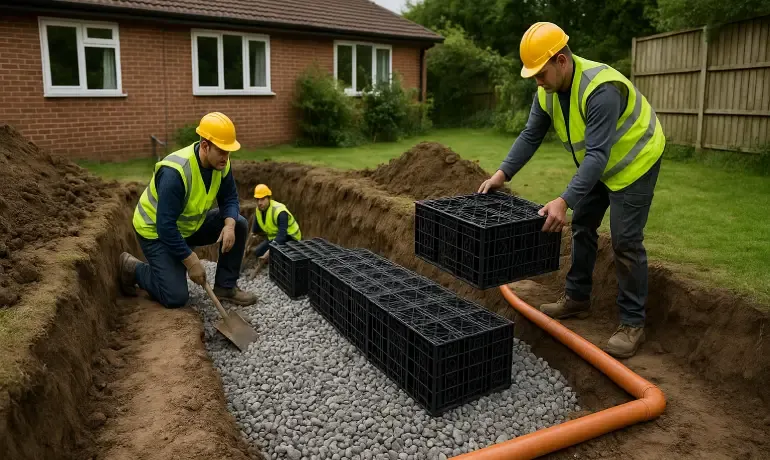
A percolation test tells you whether your ground will take water before you build a soakaway. Here is how the BRE 365 test works, why London Clay so often fails it, and which checks to ask for once a soakaway is in.
A soakaway percolation test measures how quickly water drains out of a hole dug in your ground, so that a soakaway can be sized to match, or so you find out before building one that the ground will not take water at all. After a soakaway is installed, the useful checks are different: a camera inspection of the pipe feeding it, a look inside through its access point, and a simple fill-and-watch test to confirm it empties.
What is a soakaway percolation test?
It is a timed drainage test in a trial pit dug at the depth and position of the proposed soakaway. The pit is filled with water and the time the level takes to fall is used to work out the ground's infiltration rate, which is the figure a designer needs to calculate the soakaway's size.
Two methods are in common use, and they answer slightly different questions. For rainwater soakaways, the reference is BRE Digest 365, the method most building control officers expect to see. For a drainage field taking treated effluent from a septic tank or treatment plant, Approved Document H of the Building Regulations sets out its own percolation test, carried out in smaller holes at the depth of the distribution pipes. If someone quotes you a single "perc test" figure, ask which method it came from.
How the BRE 365 test is done
A trial pit is dug to the depth the soakaway will be, filled quickly with water, and the fall in level is timed. The pit is then refilled and timed again, three times in all, and the design uses the slowest result, because the ground absorbs less once it is already wet.
The timing that matters is how long the water takes to drop from 75 per cent to 25 per cent of its starting depth. That time, the volume of water lost over it and the wetted area of the pit sides and base give the infiltration rate, usually expressed in metres per second. The three fills should be done on the same day or on consecutive days, so the ground does not dry out between them.
Things that make a result unreliable:
- Testing in a pit much shallower than the soakaway will be. Ground a metre down is often very different from ground two metres down.
- A pit that partly collapses during the test, which changes the wetted area the calculation depends on.
- Only one fill. A single fast result from dry ground flatters the soil.
- Testing in a dry summer and designing for winter, when the water table may be much higher.
The trial pit should also be left open for a while, or checked again later, to see whether groundwater seeps into it. A soakaway whose base sits in the water table cannot work, however good the soil is.
What result counts as a pass?
There is no simple pass mark for a rainwater soakaway: any measurable infiltration rate can be designed for, but a slow rate means a very large soakaway. When the calculated size becomes impractical for the garden, the ground has effectively failed.
For an effluent drainage field under Approved Document H, the test gives a figure called Vp, the average time in seconds for the water level to drop one millimetre. Ground is only considered suitable within a set range: too slow and effluent will pond, too fast and it passes into the ground before it has been treated. Your building control body will confirm the criteria for a particular site.
Soakaways also have location rules that no test result overrides. Approved Document H says a soakaway should not be built within five metres of a building or a road, or in unstable ground. Many London back gardens simply do not have a spot that far from the house, the neighbours and the boundary wall.
Why so many London percolation tests fail
Much of London sits on London Clay, which barely lets water through. A percolation test in clay often sees the water level fall by a few centimetres over hours, which translates into a soakaway too big for any domestic plot.
This is the point at which a soakaway is the wrong answer, and it is better to hear that from a test than from a flooded patio two winters later. The alternatives are usually an attenuation tank that stores rainwater and releases it slowly into the surface water sewer, rainwater harvesting, or permeable paving with a controlled outlet. Connecting surface water to a public sewer needs the water company's consent, so that conversation should happen before the design is fixed. Areas on gravels and sands, including parts of south-west and east London near the Thames terraces, often test far better, which is why a result from one street tells you little about the next.
What testing is recommended after a soakaway is installed?
Once a soakaway is built, the checks shift from the ground to the installation: is the pipe to it sound, is there a way to inspect it, and does it actually empty. Three checks cover most of it.
- A CCTV inspection of the inlet pipe. Pipes to soakaways are often laid in the same trench as other services and backfilled carelessly. A camera run from the nearest chamber records the pipe's condition, fall and joints on the day it is handed over, which is useful evidence if the system fails later.
- A look inside through the inspection point. Modern crate soakaways should have an inspection or access chamber and, ideally, a silt trap upstream. Check both exist, are accessible and are not already carrying construction silt.
- A fill-and-watch test. Running a known volume of water into the soakaway and timing how long it takes to disappear gives a baseline to compare against in future years. It is not a design check, but it shows the system is working.
Recording these in writing, with the chamber positions and the pipe route on a simple plan, gives you an as-built record. It is the document a future buyer's surveyor or an insurer will ask for, and the first thing an engineer needs when the soakaway stops draining. Our soakaway installation and clearance page explains how we survey before and after the work.
When the soakaway already exists and is not draining
A percolation test is a design tool. It is not the right first step for a soakaway that used to work and has stopped. Start by finding out why it has stopped.
The usual causes are silt and debris filling the soakaway, roots, a collapsed or blocked inlet pipe, or a rubble pit that has simply clogged with age. A CCTV survey of the inlet and, where possible, the soakaway itself separates a blocked pipe, which is a cheap fix, from a clogged soakaway, which is not. We go through the symptoms in why a soakaway stops draining. A new percolation test only becomes necessary if the answer is to build a replacement, because the ground next to an old soakaway may test quite differently from the ground under it.
Frequently asked questions
How long does a soakaway percolation test take?
The BRE 365 method needs the trial pit filled and timed three times, ideally on the same day or on consecutive days. On free-draining ground that can be done in a few hours. On clay, where the level falls very slowly, each fill can take many hours, which is itself a sign the ground may not suit a soakaway.
Do I need a percolation test for a soakaway?
For a new soakaway that building control is checking, a percolation test is normally expected, because the soakaway has to be sized from the ground's measured infiltration rate. It is not the right first step for an existing soakaway that has stopped draining; that needs a survey to find out why.
What testing is recommended after a soakaway is installed?
A CCTV inspection of the inlet pipe, a check that the inspection chamber and any silt trap are accessible and clean, and a timed fill-and-watch test to show the soakaway empties. Recorded on a simple plan, these give you an as-built record for future buyers, insurers and engineers.