How to Find a Leaking Drain: Signs, Dye Tests and CCTV
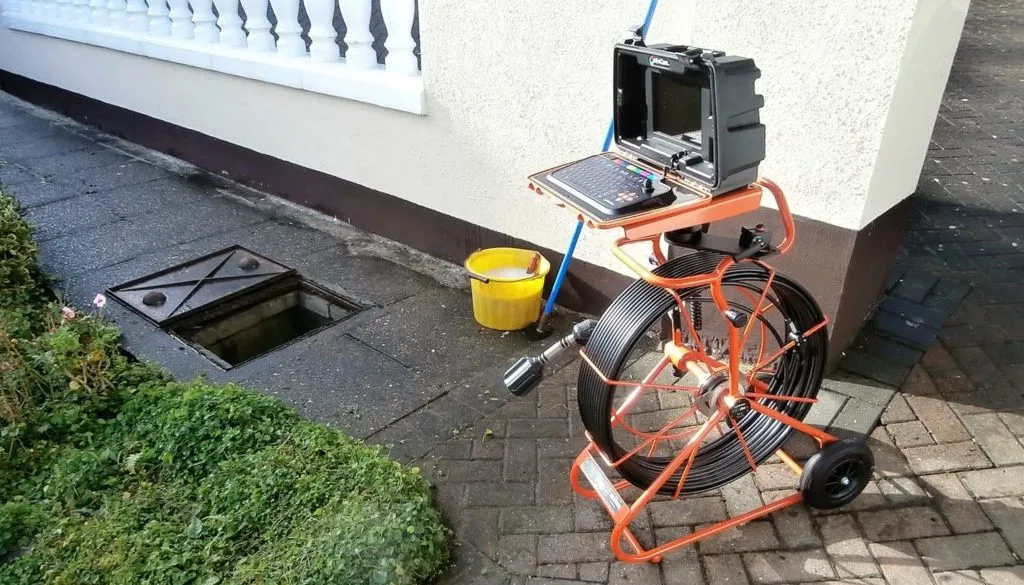
Damp after baths or rain, sinking ground and rats are the usual signs of a leaking drain. Here is how to rule out a supply pipe leak first, and how dye tests, water tests and a CCTV survey find which pipe is leaking and exactly where.
To find a leaking drain you first confirm it is the drain and not a water supply pipe, then prove the run leaks with a dye or water test, then put a camera through it to find the defect and record its exact position. Damp and sinking ground point to a leak. A CCTV survey is what tells you which pipe, how far along it and why.
This guide covers underground drains: the pipes that carry waste water and rainwater away from the building. If water is escaping from the pressurised supply pipe that brings water in, that is a different investigation, and we explain how to tell them apart below.
What are the signs of a leaking drain?
The usual signs are damp that appears after water is used or after rain, ground that softens or sinks along the line of a drain, and a smell or rats where there should be neither. None of them proves a drain leak on its own, but two or three together are a strong reason to investigate.
- Damp low on a wall near a gully or soil pipe. A patch at the base of an external wall, or on the inside face of that wall, that gets worse when the bath empties or when it rains.
- Soft, sinking or wet ground. A dip in the lawn, a paving slab that rocks, or a line of greener grass in a dry spell, following the route between the house and the manhole.
- Damp or water in a cellar or basement that tracks with water use upstairs rather than with the weather.
- Rats in the garden or under the floor. Rats live in sewers and get into gardens and buildings through broken drains, so a sudden rat problem often means an open pipe somewhere.
- New cracks in walls near a drain run. Water escaping from a pipe can wash out or soften the ground under a foundation. Cracks have many other causes, so treat this as a reason to check, not a conclusion.
- A drain smell outside with no blockage. Sewer gas escaping through an open joint can come up through the soil or paving.
Is it the drain or a water supply pipe?
Turn every tap and appliance off and watch the water meter. If it keeps moving, water is escaping from the supply side, and you need leak detection on the pressurised pipe, not a drain survey. A drain only leaks when water is put into it, so a drain leak never shows on the meter.
Timing is the other clue. Damp that appears only after rain points to rainwater pipes, gullies or a soakaway. Damp that follows baths, showers and washing machines points to the foul drain. Damp that is there all the time, whatever you do, may be a supply leak, a defective damp-proof course or condensation, and none of those is fixed by drain work. It is worth ruling them out before paying for anything.
A common drain leak in London houses is not deep underground at all. It is the gully at the foot of a rainwater or waste pipe: a cracked gully pot, a broken back inlet, or a downpipe that stops short and discharges beside the gully instead of into it. These are cheap to find and put right, which is another reason to look at the simple things first.
How a dye test shows where the water goes
A dye test adds non-toxic, high-visibility tracer dye to a sink, WC, gully or downpipe and watches where it comes out. If dyed water turns up in the damp patch, the cellar or a neighbour's chamber, you have linked that fitting to that leak without lifting a slab.
Dye testing is quick and it answers the question homeowners actually ask: is this water coming from my drain? It is also how misconnections are proved, such as a washing machine that discharges into a rainwater pipe. What dye cannot do is tell you where along the pipe the water escapes. For that the dye result is paired with a camera, which is how our drain tracing service in London works: dye to prove the connection, CCTV to follow the route.
How a water test proves a drain run is leaking
A water test seals a length of drain between two access points, fills it to a set level and measures how much water has to be added to hold that level. If the loss is higher than the allowance for that pipe size and length, the run is leaking.
It is the most direct proof that water is escaping into the ground, which is why some loss adjusters ask for it. The limits are that it gives a number rather than a location, and that an old clay drain with mortar joints will rarely hold water perfectly even when it is working well. We compare the two pressure methods in our guide to air tests and water tests on drains, including why a failed test on an old drain is a starting point rather than a verdict.
How a CCTV survey finds the leak point
A CCTV survey puts a camera through the pipe and records every defect that could let water out: cracks, fractures, open or displaced joints, root intrusion, and connections that have been broken into the side of the pipe. Each one is logged by its distance from the access point, so it can be found from the surface.
A camera does not see water leaving the pipe. It sees the hole. In practice that is enough, because a joint that has opened by several millimetres a metre upstream of the damp wall is not a coincidence. When the groundwater is high the reverse also shows up: water running in through the same defects, which confirms they are open.
The survey also sorts out ownership. It records where your pipe joins a shared drain or the public sewer, which matters because defects on the public side are the water company's to repair, not yours. A CCTV drain survey with a written, coded report gives you the defect, its position, its severity grade and which length of pipe it is on.
What should the leak investigation give you?
You should come away with evidence that someone else can check: which fitting the dye came from, the test result for each run tested, and a survey report with footage, a sketch of the drain layout and each defect located by chamber and distance.
- For a repair: the report tells a contractor whether the problem is one joint, suited to a local patch, or a whole run that needs relining or replacing. Without it, quotes are guesses.
- For an insurance claim: buildings policies often cover accidental damage to underground drains but not wear and tear, and the insurer or loss adjuster will want evidence of what failed and why. Our drainage insurance claims page covers what is usually asked for.
- For a purchase or a dispute with a neighbour: dated footage and chamber references mean everyone is talking about the same length of pipe.
Ask for the test record and the survey to use the same chamber numbers. It is a small thing, but it is what makes the evidence hang together.
When digging or relining is the wrong first step
Do not agree to excavate or reline a drain because of damp alone. Until a test or survey has shown which run leaks and where, any repair is a guess, and the most expensive guesses are the ones that dig up the wrong pipe.
If the investigation shows nothing wrong with the drains, that is a useful result too. It sends you back to the supply pipe, the gutters, the damp-proof course or ventilation, and it saves you paying for drain work you did not need.
Frequently asked questions
Can a leaking drain cause damp in the house?
Yes. A leaking drain close to the building can wet the ground against the wall and cause damp low down, especially after baths, showers or heavy rain. Damp that appears with water use or rainfall, rather than all the time, is the pattern that points to a drain rather than rising damp or condensation.
Will a leaking drain show on my water meter?
No. Drains are not under pressure and only carry water when something is emptied into them, so a drain leak does not move the meter. If the meter keeps turning with every tap off, the leak is on the water supply pipe and needs leak detection, not a drain survey.
Can a CCTV survey find a leak in a drain?
It finds the defect that is letting water out, such as a crack, fracture, open joint or root intrusion, and records its position along the pipe. It does not see the water leaving the pipe. Where proof of leakage is needed, for example for an insurer, the survey is paired with a dye or water test.